Shipboard cable serves on board vessels, offshore platforms and offshore buildings, feeding control, instrument, meter, monitoring and protection circuits plus power supplies and inverter drives, all in a humid environment. The Chinese shipboard catalogue is built to IEC 60092 with GB/T 9331 and GB/T 9332 as the national pairings — 150/250 V cable is manufactured according to IEC 60092-353:1995 & GB/T 9331-2008, 0.6/1 kV cable according to IEC 60092-376:1995 & GB/T 9332-2008. Within that system the insulation is never a free variable: it is one of three letters, each growing a defined family of type codes. This article compares the three, then assembles the selection logic. The full code anatomy is decoded in KEF, CEF, CYJY: Reading Shipboard Cable Codes to IEC 60092.
Where the letter sits
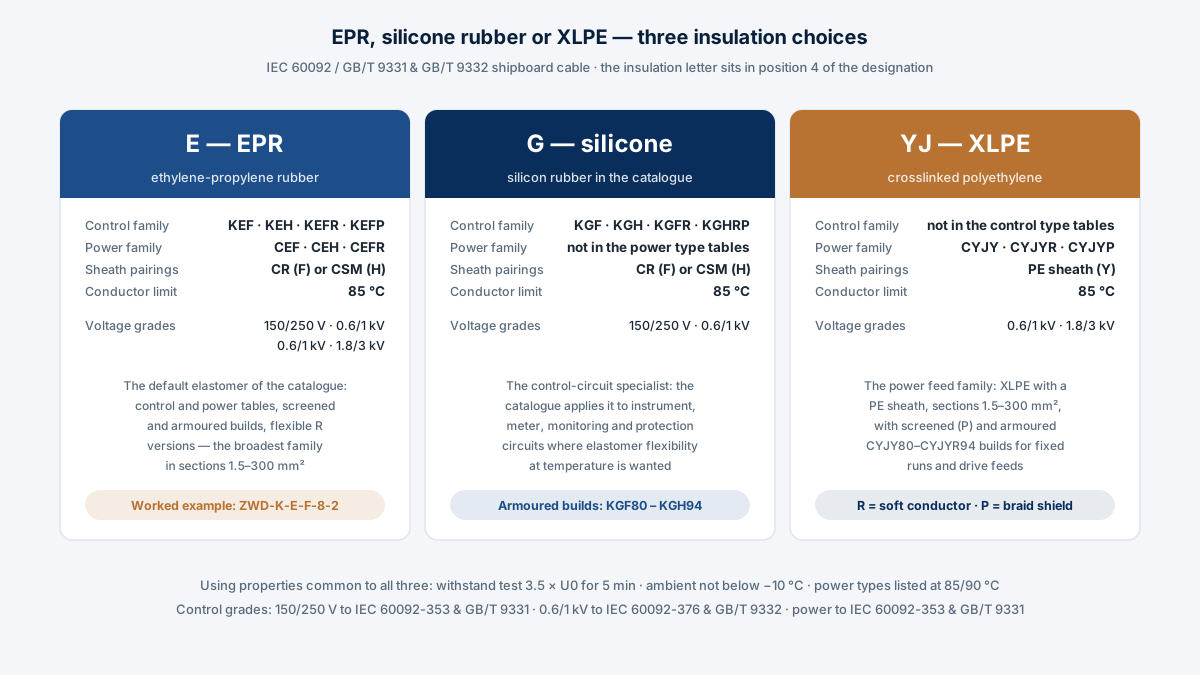
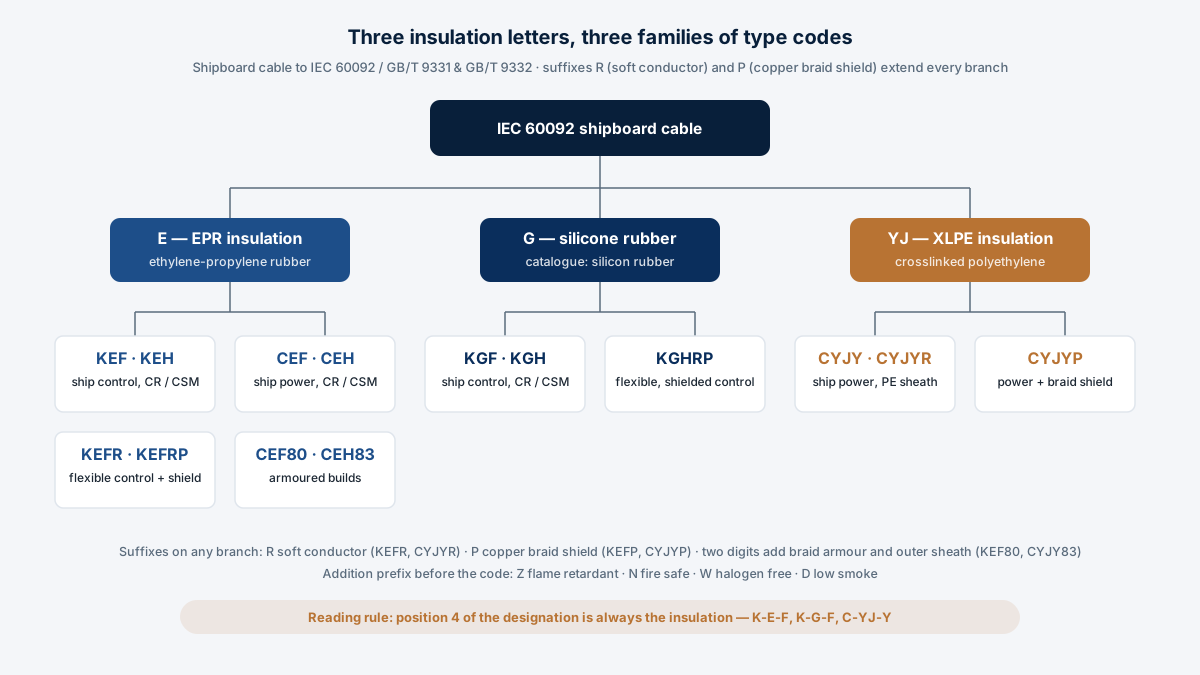
The naming rules assign seven positions: the addition prefix, the product mark, the conductor kind, the insulation material, the sheath material, the armour and the outer sheath over the armour. The insulation is the fourth, and the two schemes read it identically — control cable opens with K, ship power cable with C, and the next material letter is the insulation. The three choices the catalogue publishes are:
| Letter | Material | Control scheme (K first) | Power scheme (C first) |
|---|---|---|---|
| E | EPR — ethylene-propylene rubber | KEF, KEH, KEFR, KEFP, KEFRP, KEF80–KEF94 | CEF, CEH, CEFR, CEFP, CEF80–CEFR94 |
| G | Silicon rubber (catalogue wording) | KGF, KGH, KGFR, KGHR, KGFP, KGHRP, KGF80–KGH94 | — not in the power type tables |
| YJ | XLPE — crosslinked polyethylene | — not in the control type tables | CYJY, CYJYR, CYJYP, CYJY80–CYJYR94 |
The pattern is visible at a glance: EPR spans both schemes; silicone rubber belongs to the control family; XLPE belongs to the power family. Sheath letters follow the insulation in position five — F for CR (chloroprene rubber), H for CSM (chlorosulfonated polyethylene), and in the power scheme Y for a PE (polyethylene) sheath.
EPR — the elastomer with the widest coverage
The E families are the backbone of the catalogue. In the control scheme, KEF is the “EPR insulated CR sheathed ship control cable” and KEH the CSM-sheathed twin; the suffixes add the soft conductor (R), the copper braid shield (P) or both (KEFRP), and the armour digits extend the family from KEF80 through KEF94. In the power scheme the same insulation names CEF, CEFR, CEFP and CEFRP, the CSM-sheathed CEH series, and the armoured CEF80/90, CEF83/93 and CEFR84/94 builds — published at sections 1.5–300 mm² and a conductor temperature of 85°C. The catalogue’s own worked example is an EPR construction: ZWD-K-E-F-8-2, a flame-retardant, low-smoke, halogen-free control cable — EPR insulation, CR inner sheath, copper wire braid armour, PVC outer sheath — rated 150/250 V in 37 cores of 2.5 mm².
Across the KEF / KEFP control tables, the two voltage grades differ by one number worth checking on any drawing:
| Grade U0/U | Sections mm² | Insulation thickness | Executive-standard pair |
|---|---|---|---|
| 150/250 V | 0.5–2.5 | 0.6 mm (0.5–1.0 mm²) / 0.7 mm (1.5–2.5 mm²) | IEC 60092-353:1995 & GB/T 9331-2008 |
| 0.6/1 kV | 1.0–6.0 | 1.0 mm | IEC 60092-376:1995 & GB/T 9332-2008 |
Silicone rubber — the control family’s second elastomer
The G families mirror the E families exactly, one scheme over: KGF is the “silicon rubber insulated CR sheathed ship control cable”, KGH its CSM-sheathed twin, and the same suffix grammar applies — KGFR and KGHR for the soft, flexible-conductor versions; KGFP, KGHP, KGFRP and KGHRP for the copper-braid-shielded ones; and the full armour set from KGF80 and KGH80 through KGF94 and KGH94. Silicone appears in both control voltage grades, 150/250 V and 0.6/1 kV, at the same 85°C conductor limit as the rest of the family. What it does not appear as, anywhere in the type tables, is ship power cable — the power scheme never takes the G letter, so a silicone insulated power feed is by definition a custom build quoted from a drawing rather than a catalogue line.
XLPE — the power scheme’s crosslinked family
The YJ letters bring the thermoset-plastic option, and they arrive only in the power scheme. CYJY is the “XLPE insulated PE sheathed ship cable” — note the second Y, the PE sheath that replaces the CR/CSM elastomer sheaths of the E families — and the family runs CYJYR (soft conductor), CYJYP (copper braid shield) and the armoured CYJY80 / CYJY90, CYJY83 / CYJY93 and CYJYR84 / CYJYR94. The power tables publish it alongside the EPR power types at sections 1.5–300 mm², 0.6/1 kV and 1.8/3 kV, at 85°C — the same grades, sections and temperature limit as CEF, which makes the EPR-versus-XLPE choice a matter of sheath system and project preference rather than a different electrical envelope within this catalogue.
The 85°C line, and what pairs with what
Whatever the insulation letter, the service envelope is shared. The using properties fix the ambient at not lower than −10°C and the conductor at not above 85°C for the control family; the power family’s clause is written at 85/90°C, with every row of the power type table published at 85°C. The withstand test is 3.5 × U0 for 5 minutes without puncture — U0 being the conductor-to-earth figure of the U0/U notation explained in the voltage-class article, and for sizing the run itself the voltage-drop calculator turns section and grade into a maximum route length. Bending radii follow the scheme: at least 4×D where the overall diameter D is 25 mm or less and 6×D above it for the control family, 4×D unarmoured and 6×D armoured or shielded for power. The sheath pairings are the practical differentiators:
| Insulation | Sheath letters | Sheath materials | Named constructions |
|---|---|---|---|
| EPR (E) | F or H | CR / CSM | KEF, KEH, CEF, CEH — and every R, P and armour suffix on them |
| Silicon rubber (G) | F or H | CR / CSM | KGF, KGH — control scheme only, through KGF80–KGH94 |
| XLPE (YJ) | Y | PE — polyethylene | CYJY, CYJYR, CYJYP — power scheme, PE sheath standard |
Choosing between them
Selection reduces to four questions, and the insulation letter answers the second of them: control or power (K or C)? Insulation elastomer for the duty (E, G or YJ)? Sheath for the environment (F, H or Y)? Flexible, screened or armoured (R, P or the two armour digits — decoded in the armour article)? Applied to the insulation choice alone:
| The circuit | The letter | The construction basis |
|---|---|---|
| Control, instrument, meter, monitoring and protection circuits | E or G | KEF / KEH or KGF / KGH, sheath F or H by environment; R versions for soft, indoor mobile requirements |
| Control circuits near interference sources | E or G + P | KEFP, KEFRP, KGFP, KGHRP — copper braid shield added inside the sheath |
| Fixed power feeds, machinery and accommodation distribution | E or YJ | CEF / CEH (CR / CSM sheath) or CYJY (PE sheath) — same grades, sections and 85°C limit |
| Power feeds to inverter-driven deck machinery | E or YJ | The convert / variable-frequency tables carry CEF and CYJY constructions |
| Exposed or crushed cableways | any + armour digits | 8 copper or 9 steel wire braid, with 0/2/3/4 deciding the outer cover |
The families sit in the marine & shipboard cable category — the KEF / KEFP control series, CEF / CEFP power series and CEF80 / CEF83 armoured series carry the full dimension tables. For a shipboard construction outside the type tables — a silicone power build, an XLPE control build, a non-standard core count — the route is Custom by Standard, and the RFQ desk answers letter questions against a cable schedule directly, with samples of the standard series available for evaluation.