Shipboard cable serves on board vessels, offshore oil platforms and offshore buildings, feeding control, instrument, meter, monitoring and protection circuits, plus power supplies and inverter drives, all in a humid environment. The Chinese shipboard catalogue is built to IEC 60092 with GB/T 9331 and GB/T 9332 as the national pairings, and its designations — KEF, KEFRP, CEF, CYJY, CEFR84 — are assembled by position. Once the positions are learned, any code in the catalogue can be expanded into its full construction without a lookup table.
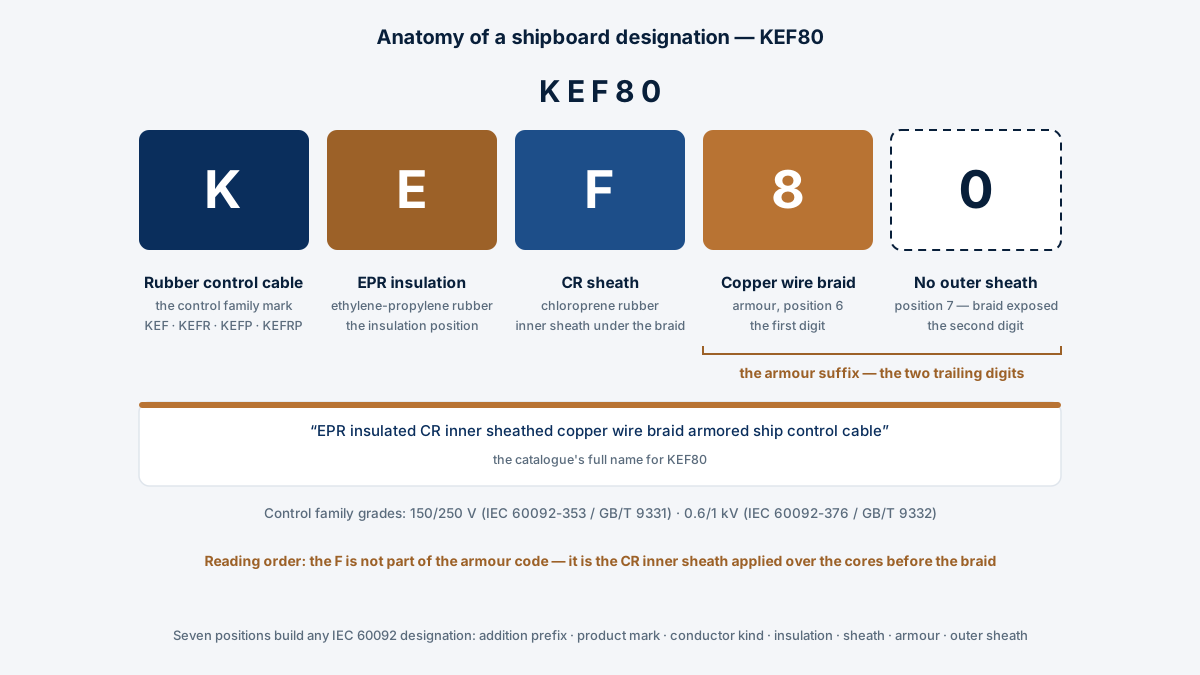
How the code is assembled
The naming rules define seven positions: (1) an addition prefix for special properties, (2) the product mark, (3) the conductor kind, (4) the insulation material, (5) the sheath material, (6) the armour, and (7) the outer sheath over the armour. The control scheme and the power scheme use the same skeleton with slightly different letters. The catalogue’s worked example for the control scheme spells a complete designation piece by piece: ZWD-K-E-F-8-2, 150/250 V, 37 cores of 2.5 mm² — a flame-retardant, low-smoke control cable carrying EPR insulation, CR sheath, copper wire braid armour and a PVC outer sheath, with W the halogen-free addition as defined in the power-scheme property letters.
| Letter | Meaning | Appears in |
|---|---|---|
| K | Rubber control cable | KEF, KEFR, KEFP, KEFRP |
| C | Ship power cable | CEF, CEFR, CYJY, CYJYP |
| B | Stranded conductor (omitted from the code) | Implied in all non-R types |
| R | Soft (flexible) conductor | KEFR, CEFR, CYJYR |
| E | EPR: ethylene-propylene rubber insulation | KEF, CEF, CEH |
| G | Silicon rubber insulation | KGF, KGHP |
| YJ | XLPE: crosslinked polyethylene insulation | CYJY, CYJYR, CYJYP |
| F | CR: chloroprene rubber sheath | KEF, CEF, KEF80 |
| H | CSM: chlorosulfonated polyethylene sheath | KEH, CEH, KGH |
| Y | PE: polyethylene sheath (power scheme) | CYJY |
| P | Copper braid shield | KEFP, CEFP, CYJYP, KEFRP |
| 8 / 9 | Copper / steel wire braided armour | KEF80, CEF90 (see the armour article) |
| Z/ZR, N, W, D | Addition prefix: flame retardant, fire safe, halogen free, low smoke | ZWDKEF82 |
The control family: K first
Every type in the control family starts with K. Four insulation-and-sheath combinations cover the stranded versions — EPR or silicon rubber insulation, CR or CSM sheath — and the suffixes add the flexible conductor, the braid shield, or both. Representative rows from the type table:
| Type | Conductor | Catalogue name |
|---|---|---|
| KEF | strand | EPR insulated CR sheathed ship control cable |
| KEH | strand | EPR insulated CSM sheathed ship control cable |
| KGF | strand | Silicon rubber insulated CR sheathed ship control cable |
| KGH | strand | Silicon rubber insulated CSM sheathed ship control cable |
| KEFR | soft | EPR insulated CR sheathed ship control flexible cable |
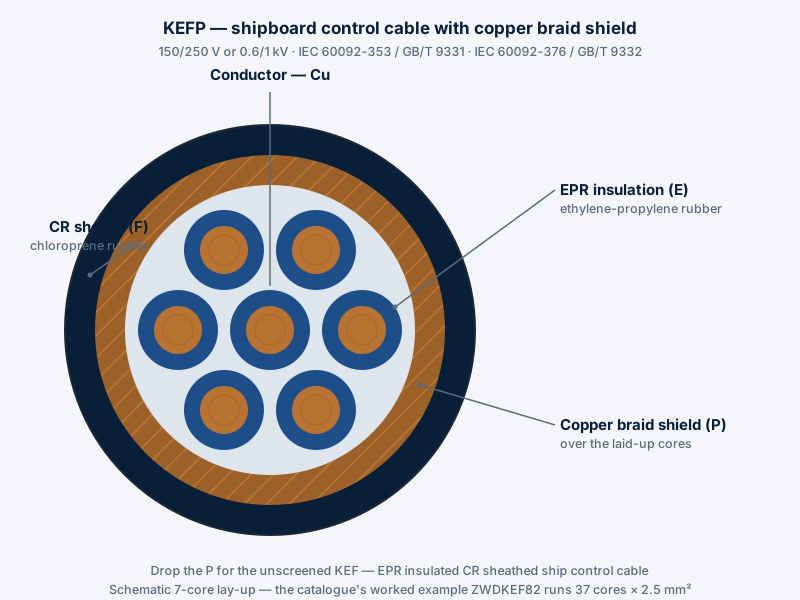
| KEFP | strand | EPR insulated copper braid shield CR sheathed ship control cable |
| KEFRP | soft | EPR insulated copper braid shield CR sheathed ship control flexible cable |
| KGHRP | soft | Silicon rubber insulated copper braid shield CSM sheathed ship control flexible cable |
Two voltage grades cover this family, and the grade determines the standard pair: 150/250 V cable is manufactured according to IEC 60092-353:1995 & GB/T 9331-2008, while 0.6/1 kV cable is manufactured according to IEC 60092-376:1995 & GB/T 9332-2008. The KEF / KEFP control series and the KEFR / KEFRP flexible control series carry both grades with full dimension tables.
The power family: C first — CEF, CEH, CYJY
The power scheme mirrors the control scheme with C for ship cable, and it adds two letters the control scheme does not use: YJ for XLPE insulation and Y for a PE sheath. CEF, CEFR, CEFP and CEFRP follow the EPR/CR pattern; CEH types take the CSM sheath; and CYJY is the XLPE insulated, PE sheathed construction. The full power table lists sections from 1.5 to 300 mm² at a conductor temperature of 85°C:
| Type | Conductor | Catalogue name |
|---|---|---|
| CEF | strand | EPR insulated CR sheathed ship cable |
| CEFR | soft | EPR insulated CR sheathed ship flexible cable |
| CEFP | strand | EPR insulated copper braid shield CR sheathed ship cable |
| CEFRP | soft | EPR insulated copper braid shield CR sheathed ship flexible cable |
| CEH | strand | EPR insulated CSM sheathed ship cable |
| CYJY | strand | XLPE insulated PE sheathed ship cable |
| CYJYR | soft | XLPE insulated PE sheathed ship flexible cable |
| CYJYP | strand | XLPE insulated copper braid shield PE sheathed ship cable |
Armoured and sheathed-over-armour versions extend both families — CEF80/90, CEF83/93 and CEFR84/94, with CYJY equivalents — which are decoded in the companion article 80, 83, 90, 94: What the Numbers on Armoured Shipboard Cable Mean. The power types are also built as convert (variable-frequency) cables for inverter-driven deck machinery, listed in the CEF convert / variable-frequency series.
Worked examples: reading real designations
Three designations, expanded letter by letter, show the system at work. KEFRP is a rubber control cable (K) with EPR insulation (E), CR sheath (F), soft conductor (R) and copper braid shield (P) — the flexible, screened control cable for mobile indoor use. CYJYP is a ship power cable (C) with XLPE insulation (YJ), PE sheath (Y) and copper braid shield (P). ZWDKEF82 prefixes the control scheme with the addition properties — flame retardant and low smoke, with W the halogen-free addition as defined in the power-scheme property letters — then reads K (control), E (EPR), F (CR sheath), 8 (copper wire braid armour) and 2 (PVC outer sheath): the catalogue’s example is rated 150/250 V in 37 cores of 2.5 mm².
Voltage classes, temperature limits and bending radii
Two voltage grades dominate the shipboard catalogue — 150/250 V and 0.6/1 kV for control, 0.6/1 kV and 1.8/3 kV for power — and the using properties fix the rest of the envelope:
| Property | Requirement |
|---|---|
| Rated voltage U0/U | 150/250 V or 0.6/1 kV (control); 0.6/1 kV or 1.8/3 kV (power) |
| Voltage withstand test | 3.5 × U0 for 5 min, without puncture |
| Operating temperature | Ambient not lower than −10°C; conductor not above 85°C (power types listed at 85/90°C) |
| Minimum working bending radius — control (150/250 V KEF types) | ≥4×D (D≤25 mm), ≥6×D (D>25 mm) |
| Minimum working bending radius — power (CEF/CYJY types) | ≥4×D unarmoured, ≥6×D armoured or shielded |
| Laying | R types (KEFR, CEFR, KEFRP, CEFRP) for soft, indoor mobile requirements; other types mainly for fixed laying |
The 150/250 V control grade pairs with IEC 60092-353 / GB/T 9331, the 0.6/1 kV grade with IEC 60092-376 / GB/T 9332, and ship power cable with IEC 60092-353 / GB/T 9331 — the same dual-standard approach described for rubber cable in IEC 60245 vs GB/T 5013. The voltage notation itself is unpacked in From 300/300 V to 8.7/10 kV.
Choosing within the families
Selection reduces to four questions. Control or power (K or C)? Insulation elastomer for the thermal and electrical duty (E EPR, G silicon rubber, YJ XLPE)? Sheath for the environment (F CR, H CSM, Y PE)? Flexible or fixed (R or not), screened or not (P or not), armoured or not (two trailing digits or none)? The marine & shipboard cable category organises the series along exactly these lines, the CEF / CEFP power series carries the power dimension tables, and the RFQ desk answers code questions against your cable schedule — samples of the standard series are available for evaluation, and small orders start at 500 m.