Swedish grid utilities write their cable requirements in national SS designations — N1XE, AXLJ-F, AXAL-TT — rather than harmonised EN 50525 or IEC types, and none of those designations belong to the harmonised international catalogs. Every letter has to be decoded into construction data first; that is where a standard catalog ends and custom-by-standard work begins. This case summarises one such requirement — de-identified to the customer, its country and its working condition — and the products it asked of us.
The customized products
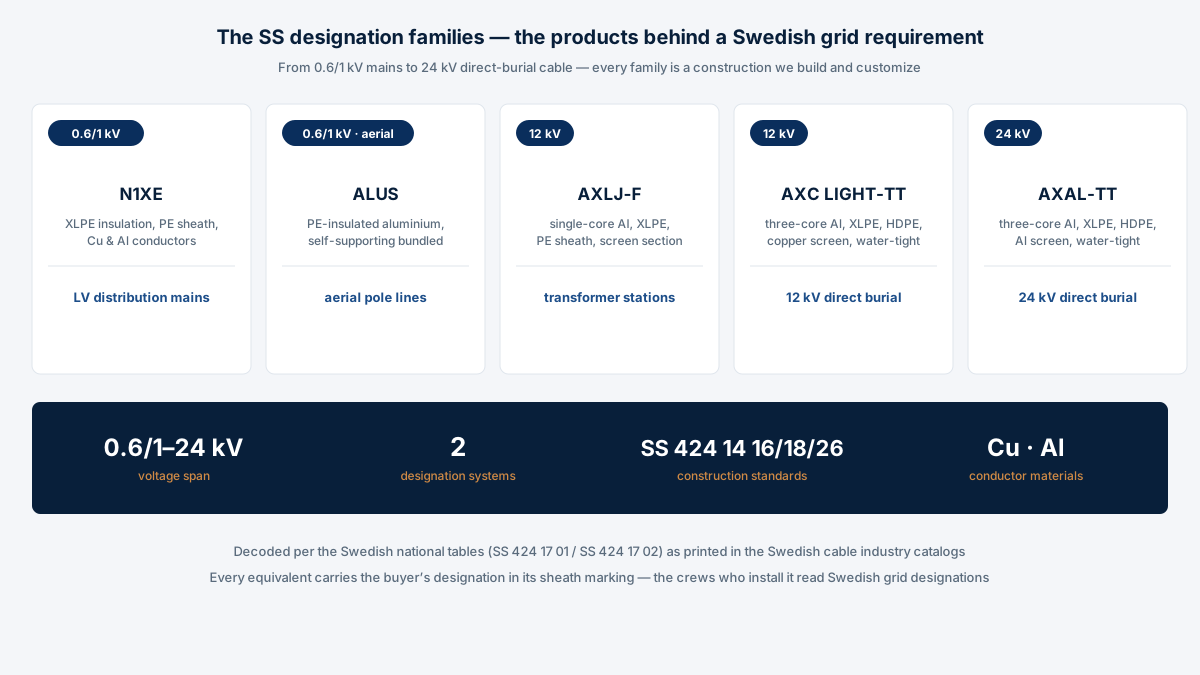
The Swedish grid-cable families are all constructions we build and customize to the Swedish SS standards — copper and aluminium conductors, XLPE insulation, PE and HDPE sheaths, metallic screens, water-tightness where the grid buries its cable. The table shows the families behind this case, and the figure above shows how they cover the grid’s voltage span.
| Family | Voltage | Construction | Duty |
|---|---|---|---|
| N1XE | 0.6/1 kV | Cu & Al · XLPE · PE sheath · solid, stranded or sector conductors | LV distribution mains |
| SE-N1XE | 0.6/1 kV | five-core type in the CENELEC-style code | LV mains with an additional core |
| ALUS | 0.6/1 kV | Al · PE insulation · self-supporting bundled | aerial pole-line service |
| AXLJ-F | 12 kV | Al single-core · XLPE · PE sheath · screen by cross-section | transformer stations, switchyards |
| AXC LIGHT-TT | 12 kV | three-core Al · XLPE · HDPE · copper-wire screen · water-tight | direct-burial / plough-in MV |
| AXAL-TT | 24 kV | three-core Al · XLPE · HDPE · aluminium-wire screen · water-tight | MV direct burial |
The LV mains follow SS 424 14 18, the three-core MV types SS 424 14 16 and the aerial family SS 424 14 26 — each construction validated field by field in the 48-hour technical review. And every equivalent carries the buyer’s designation in its sheath marking, because the crews who install it read Swedish grid designations, not IEC ones.
How the designations read
Swedish cable designations follow two published letter systems, and a grid requirement typically carries both. The modern SS 424 17 02 code (CENELEC style) writes the low-voltage mains families: N is a national type built to the Swedish SS series, 1 is 0.6/1 kV, X is XLPE insulation, E is a PE outer sheath. Conductor suffixes come from EN 60228: -U is a solid round conductor (class 1), -R a stranded round conductor (class 2), -AS an aluminium conductor of stranded, sector-shaped cross-section. The SE- prefix is simply Sweden’s two-letter country code in the CENELEC designation system — the same cable family, written the international way.
The classic SS 424 17 01 code, still used for the MV families, reads from the inside out: A is an aluminium conductor, X is XLPE insulation, L is a PE — on the three-core types, HDPE — sheath, J marks a construction rated for direct burial. Where a screen letter appears, C is a concentric copper-wire screen and A an aluminium-wire screen — the AXAL-TT family; the AXLJ-F articles specify their screen by cross-section instead. The suffix TT (totaltät) means totally water-tight in both directions: radially, through an aluminium laminate bonded to the sheath, and longitudinally, through swelling elements — the construction Swedish grid practice demands of plough-in and direct-buried medium-voltage cable.
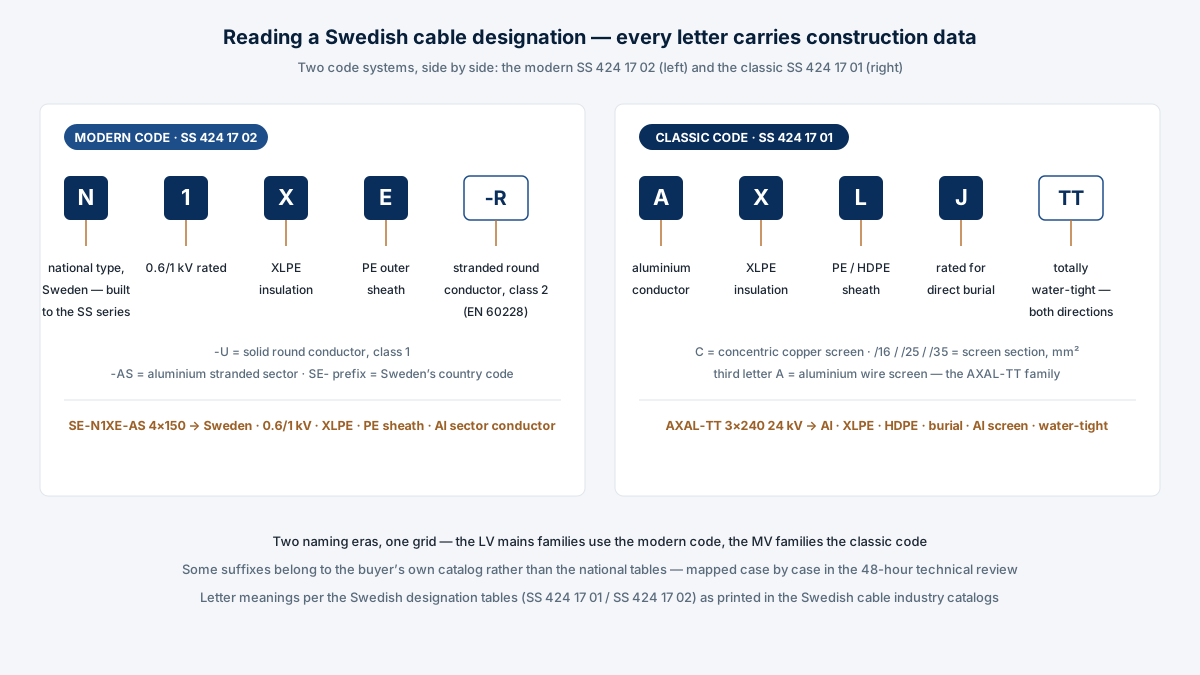
Some suffixes belong to the buyer’s own catalog rather than the national letter tables; they are read against the buyer’s specification and mapped case by case. That is what the 48-hour technical review is for: by the end of it, every designation is a validated construction sheet, not a string of letters.
How such an answer runs
An equivalent runs through the same five-step flow as any custom order. The 48-hour technical review decodes each designation into a validated construction sheet — conductor, insulation, sheath, screen, water-tightness, voltage class. Samples of the equivalent construction are produced and tested within 7–15 days of the review, rush slots typically 5. Small-batch production runs about 25 days, rush around 15, and every production batch leaves with routine test reports — conductor resistance, high-voltage withstand, insulation resistance — alongside the CoC. Equivalents of national types are custom-by-standard productions, quoted by production run, with the quantity confirmed at quotation — the same low-MOQ entry as any TongYuan order.
Where national designations sit in our work
This case is one instance of the service described in Custom by Standard: BS, VDE, NF, UNE, EN 50525, IEC, GB — and the Swedish SS families — are one discipline: read the designation, validate the construction, sample it, produce it, document it. The five-step flow such an answer runs through is described in From Drawing to Delivery; the buyer-side checks that make such an answer verifiable are collected in the buying checklist; and the low-voltage sections of a grid bill of materials can be re-checked against route length with the voltage-drop calculator before the order is confirmed. If your market’s requirement is written in a national designation we have never built, the RFQ desk is the entry point: the specification alone is enough to start, the 48-hour review decodes it, and the first response comes within 3 working hours.