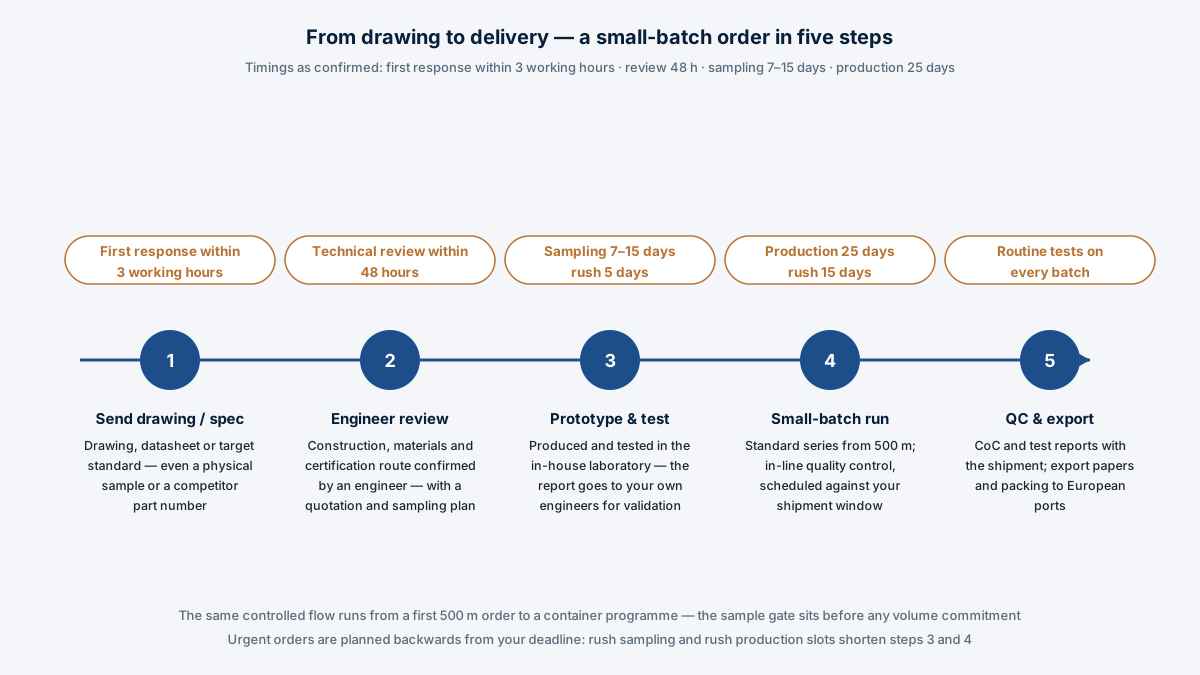
The orders big factories decline are where this process begins. A European buyer with a 500 m requirement, a non-standard core assembly or a niche duty condition does not need a different process from a container programme — it needs the same process, made visible. This article follows a small-batch custom cable order from the first enquiry to the export documents, step by step: what happens, what the buyer does at each gate, and what the buyer holds at the end of it. The five steps and their timings are the confirmed working method: 3 working hours to first response, 48 hours to technical review, 7–15 days to a tested sample, about 25 days of small-batch production, then QC and export.
Step 1 — send the drawing, specification or sample
An order starts with whatever the buyer already has. A drawing or datasheet, a tender annex, a target standard, a marked-up photograph — all of it starts the flow. Two entries need no paperwork at all: a physical sample of the cable being replaced can be mailed, and the laboratory dissects it — conductor, insulation, armour, sheath — to reverse-engineer the construction; and a competitor or catalogue part number, European, Chinese or the buyer’s own internal code, can be cross-referenced directly into a construction and quoted as a custom equivalent. The desk that receives it answers within 3 working hours — that is the confirmed first-response commitment, and it is an acknowledgement with a name on it, not an autoresponder.
Step 2 — the 48-hour technical review
Every enquiry is read by an engineer, not a sales script. Within 48 hours the review confirms three things: the construction (cores, sections, voltage class, the layer build), the materials (insulation and sheath compounds against the duty condition — heat, oil, weather, flame, halogen-free), and the certification route (the standard pair the product will be built and marked against — IEC, EN 50525, BS, VDE, NF, GB, or a dual-standard combination). What the buyer receives at this gate is a validated construction sheet and a quotation with lead time — plus a sampling plan, so the next step is already scheduled. The sections and voltage class on the validated sheet can be re-checked against the route length with the voltage-drop calculator before the order is confirmed. For a European buyer this is also where the designation mapping is settled: the drawing is written once, and the sheath marking carries the designation the destination market expects, as described in the buying checklist.
Step 3 — sampling: the gate before volume
The sample step exists so that the buyer never commits to volume before the exact construction has passed. A prototype is produced and tested in the in-house laboratory within 7–15 days, and the test report is a document the buyer can hand to their own engineers — not a brochure claim. Samples of standard series are available for evaluation, normally free of charge with courier at cost; custom designs are sampled after the technical review, so what is tested is precisely what will be produced. When the calendar does not allow 15 days, rush prototype slots compress the step to typically 5 days — the order is then planned backwards from the buyer’s date, not forwards from the factory’s convenience.
Step 4 — small-batch production, about 25 days
Once the sample passes, the production run is scheduled against the shipment window. Small-batch production runs about 25 days, produced in Shanghai with in-line quality control — checks at each link of the chain, not only at the end of it. Rush production compresses the run to around 15 days for urgent orders; larger orders are scheduled by quantity, armouring and certification requirements, and phased delivery is available for project orders.
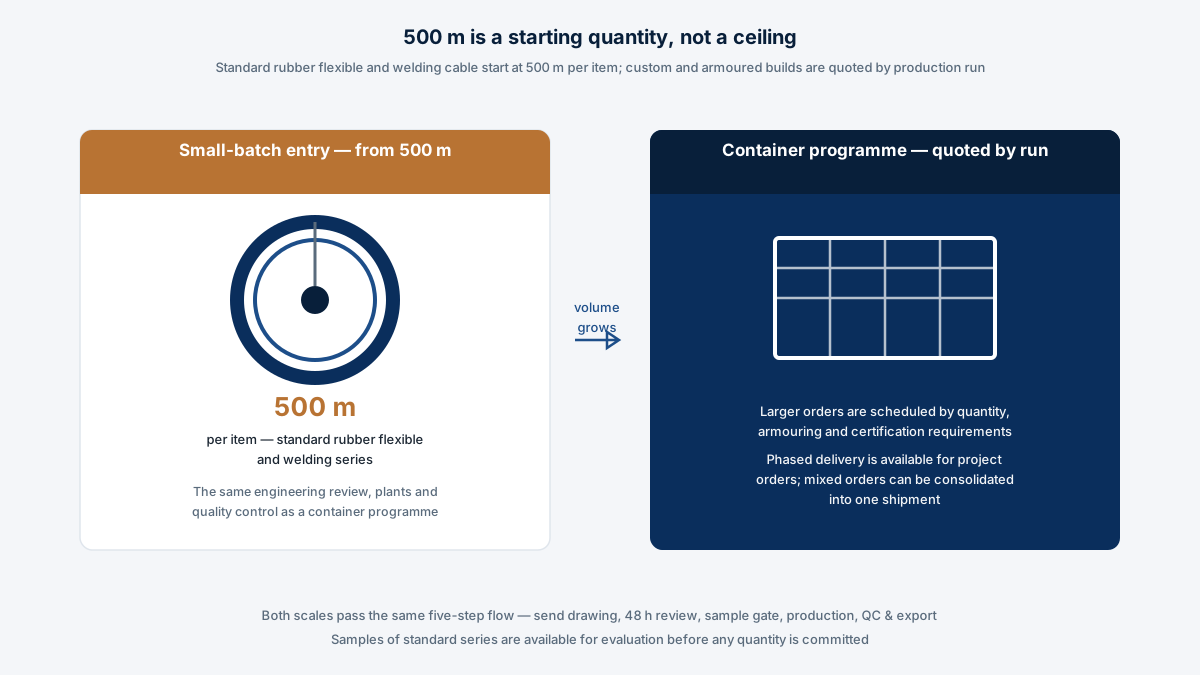
The “small” in small-batch has a precise meaning here: standard rubber flexible and welding cable start at 500 m per item, and that 500 m order receives the same engineering review, the same plants and the same quality control as a container programme. Custom or armoured constructions are quoted by production run — the target quantity belongs on the enquiry, and feasibility is confirmed with the quotation. The point of the low entry point is risk: the buyer proves the construction on 500 m, or on a sample, before scaling.
Step 5 — QC and export: what ships with the cable
The last step is the acceptance file being built, not assembled. Every production batch passes routine tests in the in-house laboratory — conductor resistance, high-voltage withstand and insulation resistance — and the test reports travel with the shipment, alongside the CoC. Third-party inspection (SGS, BV or TÜV) can be arranged before dispatch on request. Export handling covers documentation, packing lists and certificates of origin, with mixed orders consolidated into one shipment; FOB Shanghai is the default term, with CIF to major European ports and DAP on request.
The five gates on one page
| Step | The buyer | The buyer holds at the end | Confirmed timing |
|---|---|---|---|
| 1 — Send drawing / specification | Sends drawing, datasheet, target standard, physical sample or competitor part number | Acknowledgement and a contact; the enquiry is on the engineering desk | First response within 3 working hours |
| 2 — Technical review | Answers clarifying questions on duty and market | Validated construction sheet, quotation with lead time, sampling plan | Within 48 hours |
| 3 — Sampling | Reviews the sample and the test report with own engineers | Prototype and laboratory test report | 7–15 days; rush typically 5 days |
| 4 — Small-batch production | Confirms order and shipment window | Production slots scheduled against the window; in-line QC during the run | About 25 days; rush around 15 days |
| 5 — QC & export | Receives shipment and acceptance file | Batch test reports, CoC, export documentation, certificates of origin | With every batch, without exception |
Read together, the gates explain why a small order is not a worse order: the sample gate and the batch tests are the same for 500 m as for a container programme. The process behind it is described from the capability side in Custom Solutions, the standards it can be run against in Custom by Standard, and the companion article Buying Chinese Cable to European Standards covers the specification and documentation checks on the buyer’s side. To put a drawing into the flow, the RFQ desk is the entry point — small orders and samples welcome.