European buyers meet two standard numbers on almost every Chinese cable datasheet, and the meeting is friendlier than it looks: GB/T 5013 is the Chinese national adoption of IEC 60245, and the catalogue states the pairing directly — ordinary power cable is manufactured according to IEC 60245-2007 & GB/T 5013-2008. The work of buying well is therefore not decoding an alien system; it is running a short checklist that makes the alignment explicit, verifiable and documented. This article walks that checklist in five parts, using the rubber flexible families as the worked example — the same five checks apply to shipboard and mining constructions unchanged.
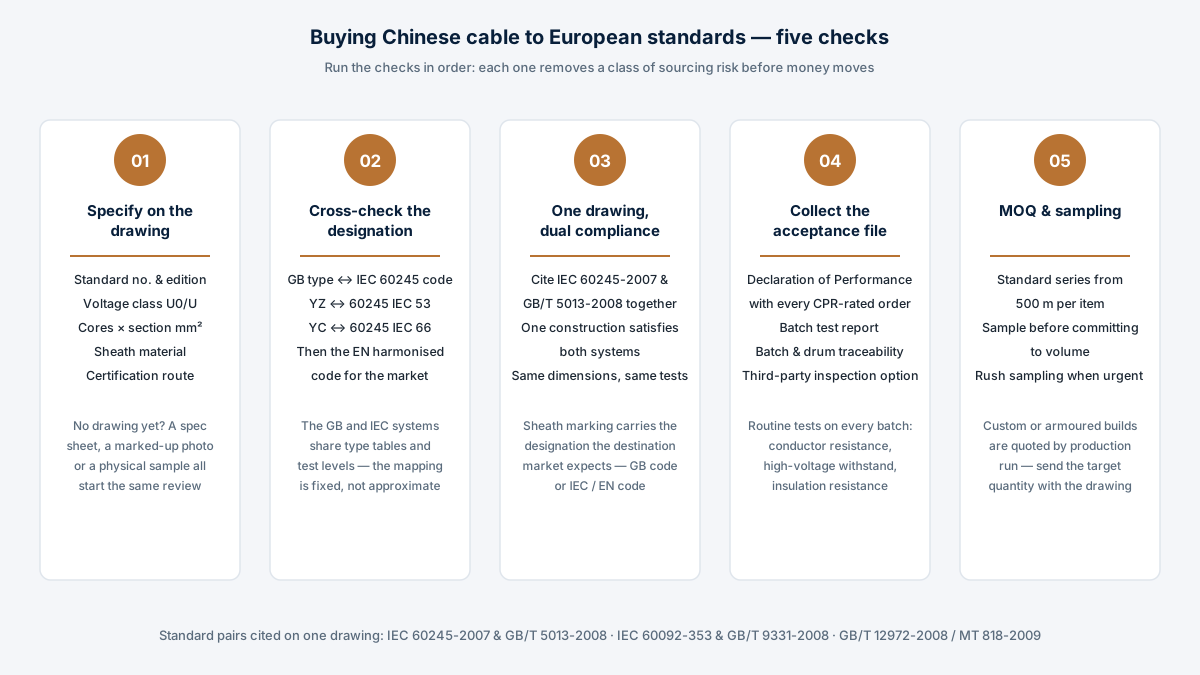
Check 1 — write the drawing so nothing is assumed
The largest source of specification drift between a European schedule and a Chinese catalogue is an under-specified drawing. A complete drawing states five things before anything else is discussed:
| Item | State it as | Worked example from the catalogue |
|---|---|---|
| Standard and edition | The executive-standard pair, both documents | IEC 60245-2007 & GB/T 5013-2008 (rubber flexible) |
| Voltage class | Rated voltage U0/U — both figures | 300/500 V (YZ), 450/750 V (YC); the notation is unpacked in the voltage-class article |
| Cores and section | Cores × section in mm², including reduced-earth assemblies | 3×25 + 3×8/3 + 3×2.5 mining builds; 3+1, 3+2, 4+1 flexible assemblies |
| Sheath material | The compound family, and the outdoor “W” suffix where UV and oil are present | Rubber sheath vs chloroprene or similar synthetic elastomer (YC vs YCW); CR, CSM or PE shipboard sheaths |
| Certification route | The designation the destination market expects on the sheath, and any CPR class | EN 50525 harmonised marking or the IEC designation; EN 50575 classes B2ca–Eca for building installations |
A formal drawing is not a precondition for starting. A datasheet, a tender annex, a marked-up photograph, a physical sample of the cable being replaced, or a competitor part number all land on the same engineering desk and are turned into a validated construction sheet — the laboratory dissects a mailed sample core by core, conductor to sheath, when that is the fastest way to specify. Two of the five entries — voltage class and cores × section — also drive the run itself: the voltage-drop calculator turns them into a route-length check before the drawing is frozen.
Check 2 — cross-check the designation in three systems
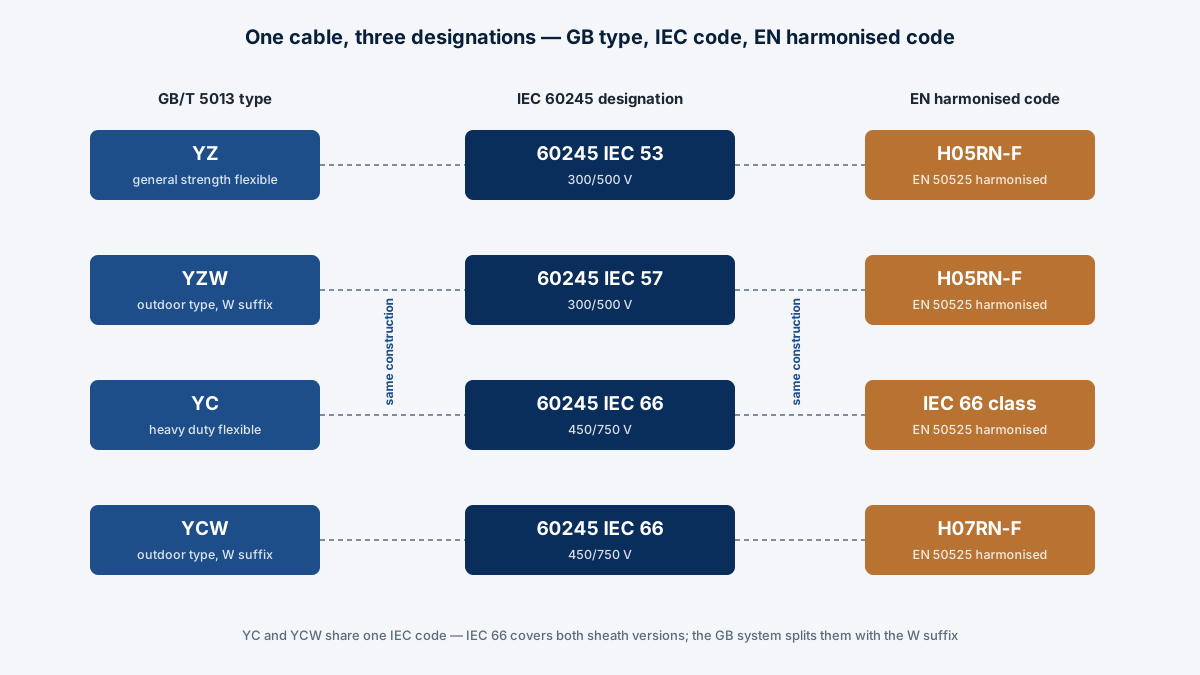
The mapping between GB type codes, IEC designations and EN harmonised codes is fixed enough to quote in a specification, because GB/T 5013 aligns with IEC 60245 type-for-type — shared type tables, shared dimension tables, shared test levels. The catalogue prints the dimension tables under combined headings such as “60245IEC66(YCW, YC)”: one table of conductor builds, insulation thicknesses, sheath thicknesses, diameters and weights serving both designations. The verification table a European buyer needs is therefore short:
| GB/T 5013 type | IEC 60245 designation | EN harmonised code | Class U0/U | Family |
|---|---|---|---|---|
| YZ | 60245 IEC 53 | H05RN-F | 300/500 V | General strength flexible |
| YZW | 60245 IEC 57 | H05RN-F | 300/500 V | General, outdoor type (W) |
| YC | 60245 IEC 66 | — (IEC 66 class; harmonised: see YCW) | 450/750 V | Heavy duty flexible |
| YCW | 60245 IEC 66 | H07RN-F | 450/750 V | Heavy duty, outdoor type (W) |
| YH / YHF | 60245 IEC 81 / 82 | — | listed without U0/U | Welding machine cable |
Note the one asymmetry worth remembering: YC and YCW share a single IEC designation, because IEC 66 covers both the rubber-sheath and the outdoor elastomer-sheath versions — the GB system splits them with the W suffix. The full standard-by-standard comparison is unpacked in IEC 60245 vs GB/T 5013, and the type-by-type behaviour in YQ, YZ, YC, YH — a field guide to Chinese rubber cable types.
Check 3 — dual compliance on one drawing
Because the type designations, dimensions and test levels coincide, a single specification sheet can cite both standards without splitting the construction. Write the drawing once — type, core count, section, voltage class, elastomer — and let the sheath marking carry the designation the destination market expects, whether that is a GB code such as YCW, an IEC code such as 60245 IEC 66, or a harmonised EN 50525 marking for free circulation in the EEA. The same dual-standard approach runs through the whole catalogue: 150/250 V shipboard control cable pairs IEC 60092-353:1995 with GB/T 9331-2008, 0.6/1 kV shipboard control cable pairs IEC 60092-376:1995 with GB/T 9332-2008, and mining cable runs to GB/T 12972-2008 / MT 818-2009. Where a project needs a European national standard instead — BS 5467, BS 6724, VDE or NF structures — the Custom by Standard route prices the same construction against that specification.
Check 4 — demand the acceptance file
A cable that arrives without documents is a cable that cannot be accepted. The file to agree before ordering is short, and every item in it is anchored to a standard or a routine practice:
| Document | When it applies | Anchored to |
|---|---|---|
| Declaration of Performance (DoP) | Every CPR-rated order — cables permanently installed in buildings | EN 50575 under the Construction Products Regulation (EU) No 305/2011; the CE marking carries the compliance, fire classes B2ca–Eca per EN 13501-6 |
| Batch test report | Every production batch | Routine tests: conductor resistance, high-voltage withstand, insulation resistance — the report travels with the shipment |
| CoC and batch traceability | Every order | Batch codes and metre marks on the sheath; drums traceable to the production run |
| RoHS / REACH documentation | On request | RoHS Directive 2011/65/EU with batch test documentation; REACH EC 1907/2006 conformity declarations and SVHC screening against the current ECHA candidate list |
| Third-party inspection report | Before dispatch, at the buyer’s request | SGS, BV or TÜV inspection arranged prior to shipment |
Two details make the CPR row workable in practice. First, since 1 July 2017, power, control and communication cables intended for permanent installation in buildings must be CE marked under the Construction Products Regulation, with fire performance classified to EN 50575 — typically Cca or Dca low-smoke designs in these families. Second, the compliance itself is carried by the CE marking plus the DoP; AVCP System 1+ or System 3 assessment is supported as the project requires. None of this needs negotiating case by case — it is the standing acceptance file.
Check 5 — structure the order: MOQ, sampling, terms
The commercial checks are as standardised as the technical ones. Standard rubber flexible and welding cable start at 500 m per item; custom or armoured constructions are quoted by production run, so the target quantity belongs on the drawing. Samples of standard series are available for evaluation, normally free of charge with courier at cost, and custom designs are sampled after the technical review — the exact construction intended for the volume order is the one that gets tested. Common payment terms are T/T and L/C at sight, typically 30% T/T deposit with the balance before shipment, confirmed per order. Shipping runs FOB Shanghai by default, with CIF to major European ports and DAP on request; export documentation, packing lists and certificates of origin are handled with the shipment. How the whole flow runs step by step — from the first enquiry to the routine tests on the final batch — is followed in From Drawing to Delivery.
Five checks, one file, one drawing: that is the whole method. The rubber & flexible category, marine & shipboard category and mining cable category carry the standard families with full dimension tables; for constructions outside them, the route is Custom Solutions, and the RFQ desk answers checklist questions directly, with samples of the standard series available for evaluation.