Every type table in the Chinese cable catalogue carries a column headed “Voltage (V)” or “Voltage:U0/U”, and the figures in it do more work than a single rating would. 300/300, 450/750, 0.38/0.66, 8.7/10 — these pairs are the voltage class of the cable, written as two numbers with distinct meanings, and they are the first thing a specification writer checks when matching a GB type code to a European system voltage. This article reads the notation, then walks the ladder family by family.
What U0/U means
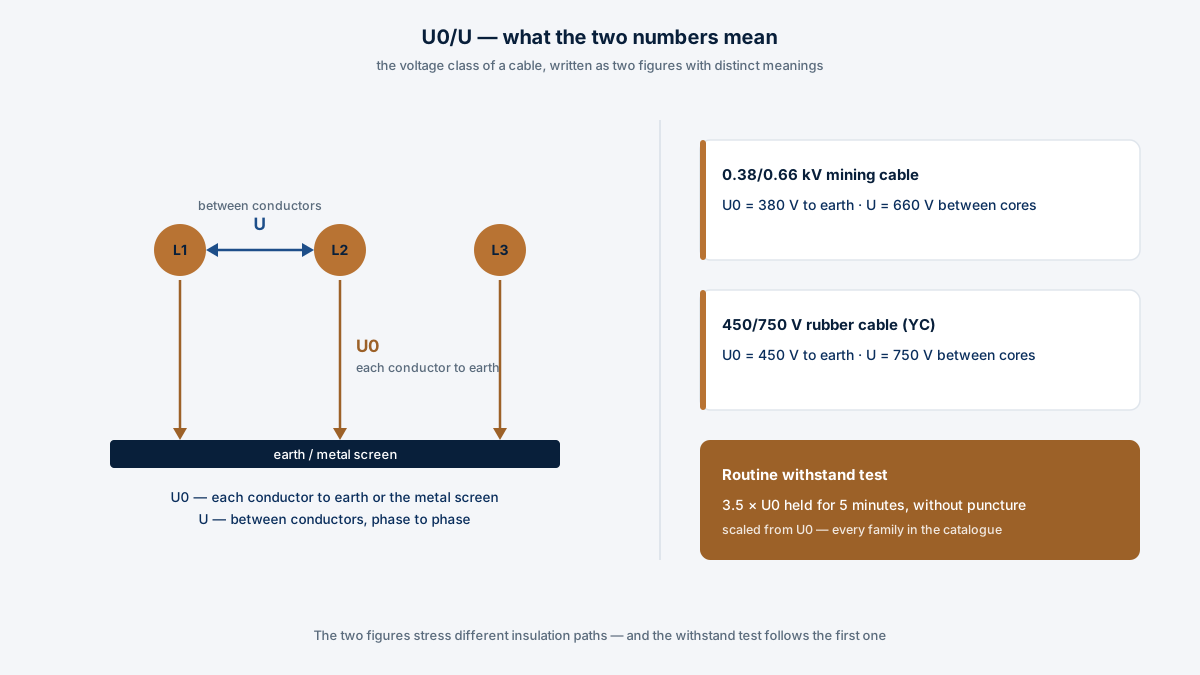
The using-property clauses open with “Rated Voltage: U0/U” followed by the pair. U0 is the rated power-frequency voltage between each conductor and earth or the metal screen around it; U is the rated voltage between conductors (phase to phase). A 0.38/0.66 kV mining cable therefore sees up to 380 V between any core and earth and up to 660 V between cores; a 450/750 V rubber cable sees 450 V to earth and 750 V between cores. The notation matters because the two figures stress different insulation paths, and because the routine withstand test is scaled from the first one: every family in the catalogue is tested at 3.5 × U0 held for 5 minutes without puncture — rubber, shipboard and mining alike.
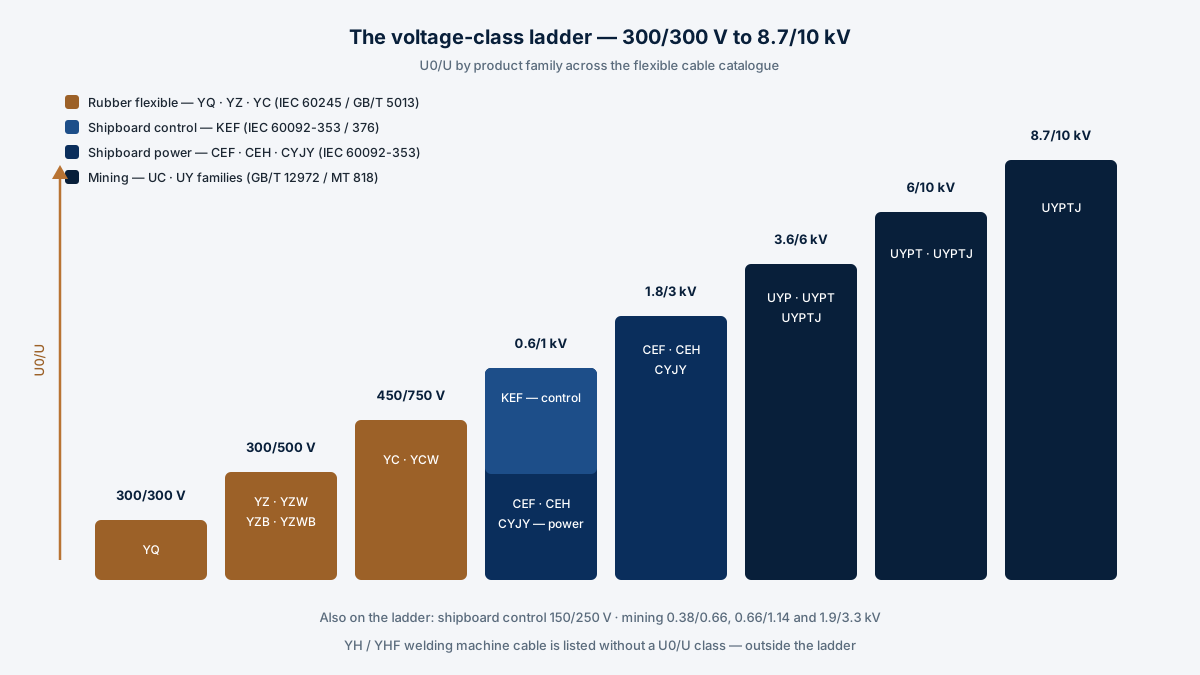
The rubber flexible ladder: 300/300, 300/500, 450/750 V
The rubber flexible families to IEC 60245 / GB/T 5013 divide into three voltage classes, and the class tracks the duty rating of the cable:
| Class U0/U | Types | Duty |
|---|---|---|
| 300/300 V | YQ | Light duty rubber sheath flexible cable — 0.5 mm², 2–5 cores |
| 300/500 V | YZ, YZW, YZB, YZWB | General strength and medium duty (flat) flexible cables — 0.5–6 mm² (flat types from 0.5 mm²) |
| 450/750 V | YC, YCW | Heavy duty flexible cables — 1.5–300 mm² (1-core), 1.5–95 mm² (multi-core) |
| — | YH, YHF | Welding machine cables, 10–300 mm² single core — listed without a U0/U class |
The ladder is explained type by type in YQ, YZ, YC, YH — A Field Guide to Chinese Rubber Cable Types, and the families are browsable in the rubber & flexible cable category.
Shipboard grades: 150/250 V, 0.6/1 kV, 1.8/3 kV
The shipboard catalogue to IEC 60092 / GB/T 9331 & GB/T 9332 uses a finer split, because control circuits and power feeds share the same trays. Shipboard control cable is rated 150/250 V or 0.6/1 kV — and the grade decides the standard pair, 150/250 V cable being manufactured according to IEC 60092-353:1995 & GB/T 9331-2008 and 0.6/1 kV cable according to IEC 60092-376:1995 & GB/T 9332-2008. Shipboard power cable (the CEF, CEH and CYJY families) is published at 0.6/1 kV and 1.8/3 kV, and the product list summarises the family as “Ship used cable (1~3kV)”. The KEF and CEF codes themselves are decoded in KEF, CEF, CYJY: Reading Shipboard Cable Codes to IEC 60092.
Mining grades: 0.38/0.66 kV up to 8.7/10 kV
The mining family to GB/T 12972-2008 / MT 818-2009 climbs the widest ladder in the catalogue — the using-property clause alone spans 0.38/0.66 kV to 6/10 kV, and the type table tops out at 8.7/10 kV:
| Class U0/U | Types |
|---|---|
| 0.38/0.66 kV | UC, UCP, UY, UYP |
| 0.66/1.14 kV | UCP, UCPJB, UCPJR, UCPT, UCPTJ, UYP |
| 1.9/3.3 kV | UCP, UCPJB, UCPJR, UCPT, UCPTJ, UYPT |
| 3.6/6 kV | UYP, UYPT, UYPTJ |
| 6/10 kV | UYPT, UYPTJ |
| 8.7/10 kV | UYPTJ — mine moving rubber covered with metal screen and monitoring core flexible cable |
The letter codes are unpacked in Decoding Chinese Mining Cable Designations, and the families sit in the mining cable category.
Why one product family splits into so many classes
The ladder exists because insulation thickness, not the conductor, is what a voltage class buys. Higher U0 demands more insulation wall, and the catalogue shows the step directly: the same UCP / MCP coal-excavator construction in 3×25 mm² carries 1.8 mm of insulation at 0.38/0.66 kV and 2.0 mm at 0.66/1.14 kV, with the wall rising steadily through the larger sections at each class:
| Core × section mm² | Insulation TH at 0.38/0.66 kV (mm) | Insulation TH at 0.66/1.14 kV (mm) |
|---|---|---|
| 3×10+3×4.0/3+3×2.5 | 1.6 | 1.8 |
| 3×16+3×6.0/3+3×2.5 | 1.6 | 1.8 |
| 3×25+3×8/3+3×2.5 | 1.8 | 2.0 |
| 3×35+3×12/3+3×2.5 | 1.8 | 2.0 |
| 3×50+3×16/3+3×2.5 | 2.0 | 2.2 |
| 3×95+3×35/3+3×2.5 | 2.2 | 2.4 |
| 3×150+3×50/3+3×2.5 | 2.4 | 2.6 |
Three further reasons fill out the ladder. Test levels scale with class — the 3.5 × U0 withstand test rises from 1,050 V for a 300 V class to over 30 kV for 8.7/10 kV cable, so each class carries its own proof regime. Systems themselves are laddered: distribution voltages differ between a 400 V deck tool, a 660 V face machine and a 10 kV trunk feed, and the cable class must sit above the system voltage it serves. And economics: a thicker insulation wall costs weight and diameter, so a cable built only for its actual class is lighter and more flexible than one over-insulated — which matters on a reeling excavator cable. The same logic runs through the wider catalogue’s product list, from LV power cable at 0.6/1 kV through MV at 6/35 kV and HV at 110/500 kV to air bunched cable at 1–10 kV.
The ladder at a glance
One table to hold the whole climb, with each family’s executive standard and conductor temperature limit:
| Family | Types | Class U0/U | Executive standard | Conductor temp. |
|---|---|---|---|---|
| Rubber, light duty | YQ | 300/300 V | IEC 60245-2007 & GB/T 5013-2008 | 60°C |
| Rubber, general | YZ, YZW, YZB, YZWB | 300/500 V | IEC 60245-2007 & GB/T 5013-2008 | 60°C |
| Rubber, heavy duty | YC, YCW | 450/750 V | IEC 60245-2007 & GB/T 5013-2008 | 60°C |
| Shipboard control | KEF family | 150/250 V | IEC 60092-353:1995 & GB/T 9331-2008 | 85°C |
| Shipboard control | KEF family | 0.6/1 kV | IEC 60092-376:1995 & GB/T 9332-2008 | 85°C |
| Shipboard power | CEF, CEH, CYJY | 0.6/1 kV, 1.8/3 kV | IEC 60092-353:1995 & GB/T 9331-2008 | 85°C |
| Mining | UC…UCPTJ, UY…UYPTJ | 0.38/0.66 – 8.7/10 kV | GB/T 12972-2008 / MT 818-2009 | 90°C |
Read against a system voltage, the table is a shortlist generator: 400 V class installations take the 450/750 V rubber or 0.6/1 kV shipboard families, 660 V face machinery takes the 0.66/1.14 kV mining types, and 10 kV distribution takes UYPTJ at 8.7/10 kV. When a schedule needs a class or core assembly the standard tables do not cover, the Custom by Standard route prices the build — and the RFQ desk answers class questions directly, with samples of the standard series available for evaluation.