Rubber flexible cable is the workhorse of moving equipment: drive devices in wet environments, home appliances, electrical tool machines, underwater pumps and other portable electrical loads. The Chinese catalogue organises these cables under GB/T 5013 with two- and three-letter type codes, and every type carries a parallel IEC 60245 designation, so the same cable can be specified against either system. This guide walks through the five families letter by letter — with the voltage ratings, temperature limits and the outdoor “W” suffix that procurement engineers most often need to check. For the standards mapping behind these types, see the companion article IEC 60245 vs GB/T 5013.
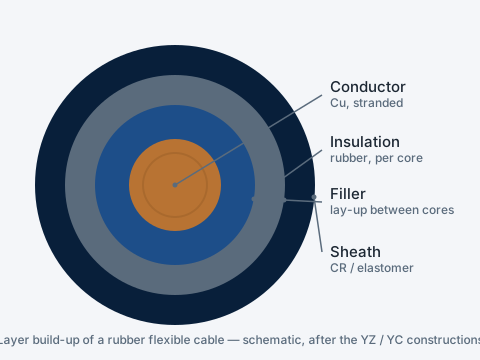
The five families at a glance
The type code encodes duty class first and construction second. YQ is the light duty family, YZ the general strength family, YC the heavy duty family and YH the welding family; the flat YZB types flatten the same general-purpose construction for tight runs. The table below condenses the full type table from the catalogue.
| Type | Catalogue name | Sections mm² | Cores | Rated voltage U0/U | Conductor temp. |
|---|---|---|---|---|---|
| YQ | Light duty rubber sheath flexible cable | 0.5 | 2–5 | 300/300 V | 60°C |
| YZ | General strength rubber flexible cable | 0.75–6 | 2–5 (3+1, 3+2, 3+3, 4+1 from 1.5 mm²) | 300/500 V | 60°C |
| YZW | General chloroprene or similar synthetic elastomer rubber flexible cable (outdoor type) | 0.75–6 | 2–5 (3+1 assemblies from 1.5 mm²) | 300/500 V | 60°C |
| YZB / YZWB | Medium duty rubber flat flexible cable | 0.5–6.0 | 2–5 | 300/500 V | 60°C |
| YC / YCW | Heavy duty rubber flexible cable | 1.5–300 (1-core); 1.5–95 (multi-core) | 1–5 (3+1, 3+2, 3+3, 4+1) | 450/750 V | 60°C |
| YH / YHF | High strength rubber welding machine used cable | 10–300 | 1 | — | 60°C |
Explore the series pages for YQ light duty, YZ / YZW general purpose and the YZB / YZWB flat cable constructions.
YQ — light duty at 300/300 V
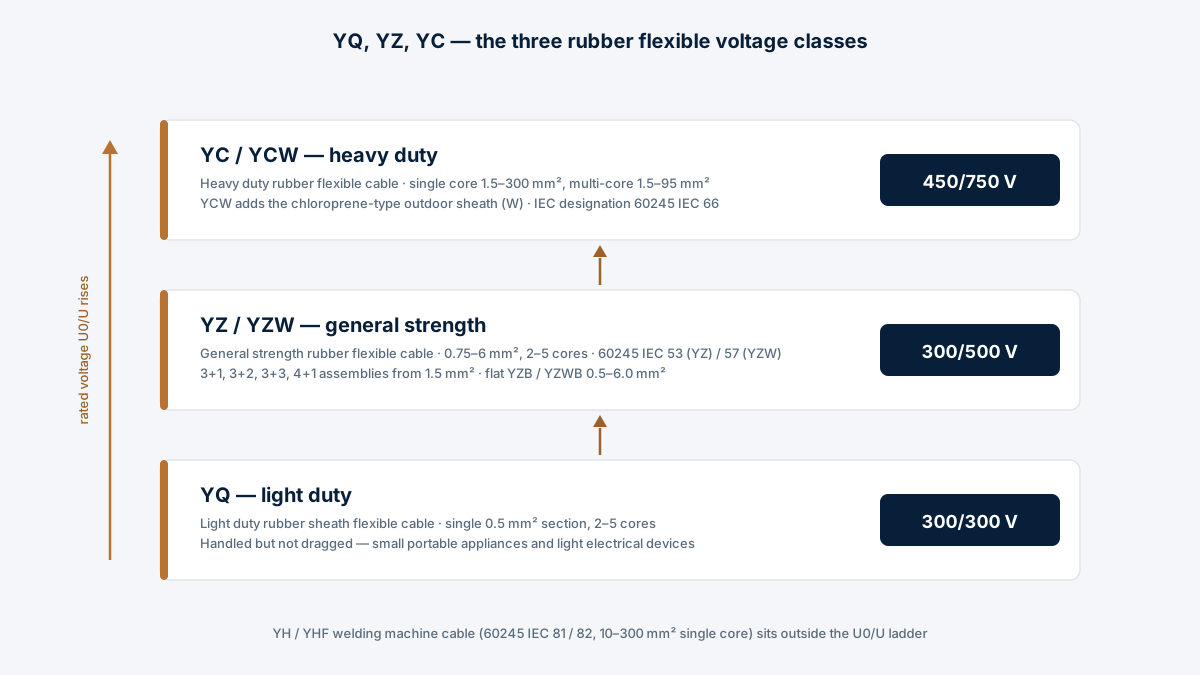
YQ is the smallest family in every dimension: a single 0.5 mm² section, 2 to 5 cores, and the lowest rating in the ladder at 300/300 V. It is the light duty rubber sheath flexible cable of the catalogue — the class used on small portable appliances and light electrical devices where the cable is handled but not dragged. The 300/300 V rating means both the conductor-to-earth and the conductor-to-conductor voltage are 300 V; the full U0/U notation is explained in From 300/300 V to 8.7/10 kV.
YZ and YZW — general purpose at 300/500 V
The YZ family is the general strength rubber flexible cable, from 0.75 to 6 mm² in 2 to 5 cores, plus reduced-earth assemblies (3+1, 3+2, 3+3, 4+1) from 1.5 mm². Its IEC counterpart is 60245 IEC 53. The W variant, YZW, is the general chloroprene or similar synthetic elastomer cable of the outdoor type — IEC designation 60245 IEC 57 — with a sheath compound chosen for weather exposure. Flat versions YZB and YZWB carry the same 300/500 V rating and 0.5–6.0 mm² range in 2–5 cores, laid flat instead of round for crane trolleys, door operators and runs where a round cable would not fit.
YC and YCW — heavy duty at 450/750 V
YC is the heavy duty rubber flexible cable: single core from 1.5 to 300 mm², and multi-core (2–5 cores, plus 3+1, 3+2, 3+3 and 4+1 assemblies) from 1.5 to 95 mm², all rated 450/750 V. The IEC designation covering both YC and YCW is 60245 IEC 66 — the catalogue prints its dimension tables under the combined heading “60245IEC66(YCW, YC)”. YCW adds the chloroprene or similar synthetic elastomer sheath of the outdoor type, which keeps the heavy duty family usable in the weather and around oily surfaces. This is the type that equates to the harmonised heavy duty H07RN-F used across Europe, a mapping the YC / YCW heavy duty series page carries in full.
YH and YHF — welding machine cable
The welding family steps outside the U0/U ladder: the catalogue lists 60245 IEC 81 (YH) and 60245 IEC 82 (YHF) as high strength rubber welding machine used cable, single core only, in large sections from 10 to 300 mm². The difference between the two is again the sheath: YH is the rubber sheath version, YHF the chloroprene or similar synthetic elastomer version. Because welding leads carry very high currents at low voltage, conductor size — not voltage class — is the selection variable; the YH / YHF welding cable page carries the full 10–300 mm² dimension table.
The GB type and its IEC 60245 designation side by side
Because GB/T 5013 aligns type-for-type with IEC 60245, a specification written in either language resolves to the same construction. The mapping used across this site is:
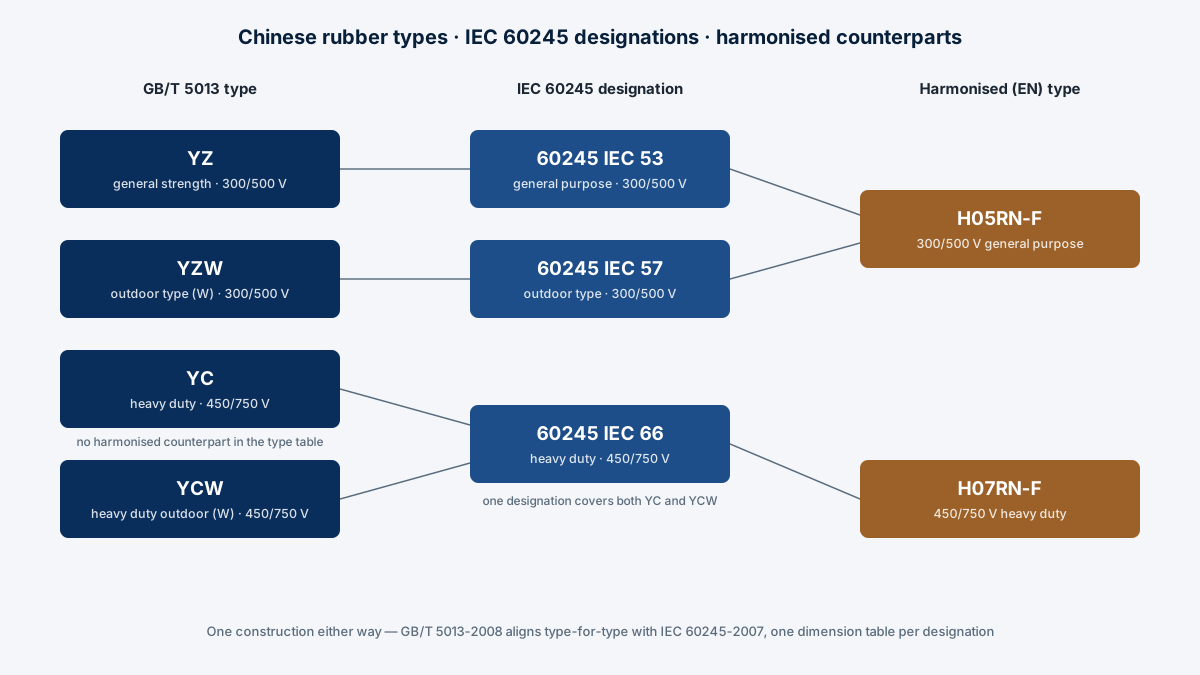
| GB/T 5013 type | IEC 60245 designation | Rated voltage | Harmonised counterpart used on this site |
|---|---|---|---|
| YQ | — | 300/300 V | — |
| YZ | 60245 IEC 53 | 300/500 V | H05RN-F |
| YZW | 60245 IEC 57 | 300/500 V | H05RN-F |
| YZB / YZWB | — | 300/500 V | — |
| YC | 60245 IEC 66 | 450/750 V | — |
| YCW | 60245 IEC 66 | 450/750 V | H07RN-F |
| YH | 60245 IEC 81 | — | — |
| YHF | 60245 IEC 82 | — | — |
Dual-standard sourcing — one drawing meeting GB and IEC requirements in the same construction — is routine for these families; the Custom by Standard page describes how a single specification sheet is written to satisfy both systems.
The W suffix — outdoor and oil-exposed duty
The catalogue’s using-property clause is specific about what W buys you: “W” type cables have weatherability performance and certain oil resistance, suiting them for outdoor usage and occasions with greasy dirt. In practice that is the dividing line between YZ and YZW, and between YC and YCW — same conductor range, same voltage class, the sheath compound changes to chloroprene or a similar synthetic elastomer. If the installation is outdoors, near machinery oil or on a dock, the W variant is the safer specification.
One test regime across the whole family
Whatever the type code, the rubber flexible families prove themselves against the same set of using properties, which is why the duty-class ladder works at all:
| Property | Requirement |
|---|---|
| Voltage withstand test | 3.5 × U0 for 5 min, without puncture |
| Yielding strength test | 15,000 return movements, no circuit breakdown or short circuit between conductors |
| Operating temperature | Ambient not lower than −10°C; conductor not above 60°C |
| Minimum working bending radius | ≥4×D where D≤25 mm; ≥6×D where D>25 mm (D = overall diameter) |
| W types | Weatherability performance and certain oil resistance, for outdoor and greasy locations |
Representative dimensions make the ladder concrete. A single-core YC / YCW to 60245 IEC 66:
| Core × Section mm² | Conductor Dia. mm | Conductor No. | Insulation TH mm | Sheath TH mm | Overall Dia. mm | Weight kg/km |
|---|---|---|---|---|---|---|
| 1×1.5 | 0.25 | 30 | 0.8 | 1.4 | 6.0 | 60.6 |
| 1×2.5 | 0.25 | 48 | 0.9 | 1.4 | 6.6 | 78.0 |
| 1×4.0 | 0.30 | 52 | 1.0 | 1.5 | 7.6 | 107 |
| 1×6.0 | 0.30 | 75 | 1.0 | 1.6 | 8.4 | 138 |
| 1×10 | 0.25 | 192 | 1.2 | 1.8 | 10.4 | 206 |
| 1×16 | 0.30 | 208 | 1.2 | 1.9 | 11.6 | 275 |
| 1×25 | 0.30 | 315 | 1.4 | 2.0 | 13.4 | 385 |
| 1×35 | 0.30 | 441 | 1.4 | 2.2 | 15.0 | 503 |
Beyond the base standard, the same families are extended with flame-retardant versions to IEC 60332 / GB/T 18380, halogen-free versions to IEC 60754 / GB/T 17650 and low-smoke versions to IEC 61034 / GB/T 17651. The full rubber & flexible cable category lists the constructions, and the RFQ form reaches the engineers who match a type code to your installation conditions.