The companion article Decoding Chinese Mining Cable Designations unpacks the whole code position by position — U for mine use, C for the coal-excavator family, Y for mine-moving. This article takes the three working letters — P, T and J — and deep-dives what each one physically adds to the cable: which layer appears, at which thickness, in which type codes, and at which voltage classes. The distinction matters at the specification desk, because the letters are not interchangeable upgrades; they answer different questions about the machine, the supply voltage and what the control system needs to see.
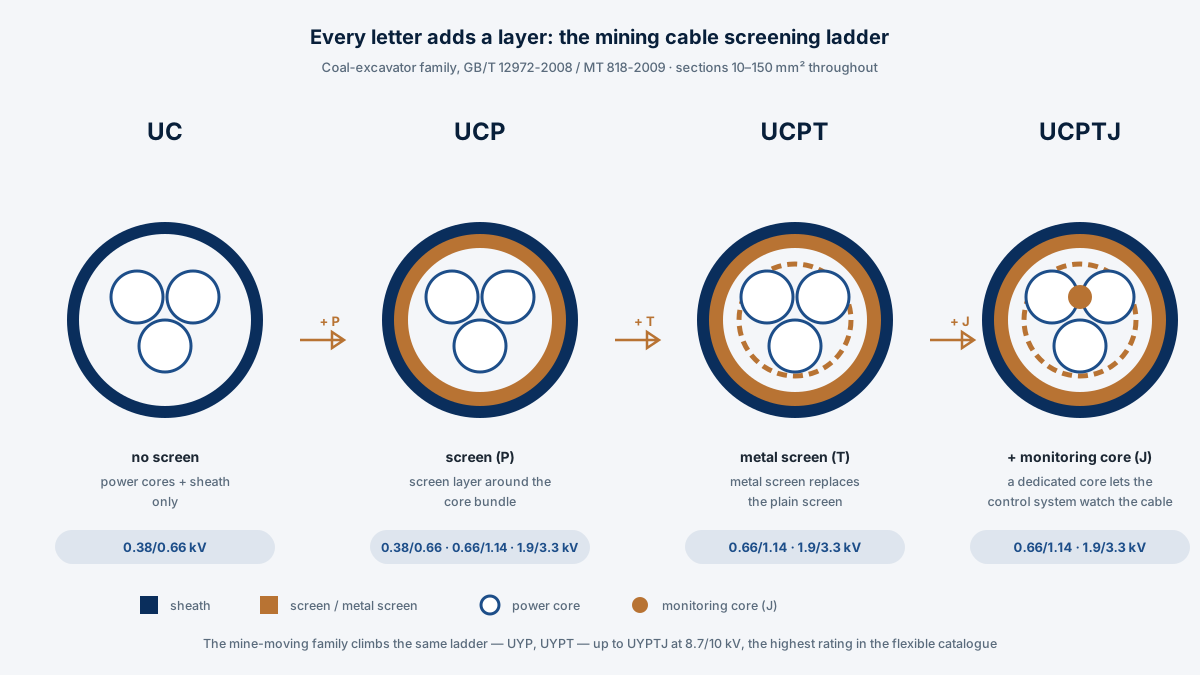
The ladder at a glance
Each letter is visible in the catalogue’s own type names, and each carries its own set of voltage classes — the sections stay 10–150 mm² throughout the family:
| Letter | What the catalogue names it | Types | Voltage class U0/U |
|---|---|---|---|
| (none) | Coal excavator used rubber covered flexible cable | UC / MC | 0.38/0.66 kV |
| P | …with screen flexible cable | UCP / MCP | 0.38/0.66, 0.66/1.14, 1.9/3.3 kV |
| P + J + B | …with screen, monitoring core and braid reinforced flexible cable | UCPJB / MCPJB | 0.66/1.14, 1.9/3.3 kV |
| P + J + R | …with screen, monitoring core and wrapped reinforced flexible cable | UCPJR / MCPJR | 0.66/1.14, 1.9/3.3 kV |
| T | …with metal screen flexible cable | UCPT / MCPT | 0.66/1.14, 1.9/3.3 kV |
| T + J | …with metal screen and monitoring core flexible cable | UCPTJ / MCPTJ | 0.66/1.14, 1.9/3.3 kV |
The first thing the table shows is that screening and voltage climb together: the unscreened UC exists only at 0.38/0.66 kV, and every letter that adds a metallic element also opens the higher classes. The second is that J never travels alone — it appears with P (UCPJB, UCPJR) or with T (UCPTJ, UYPTJ), always inside a screened construction. And at every rung of the ladder the section still has to carry the current down the route — the voltage-drop calculator checks class and section against the route length before the schedule is fixed.
P — the screen
The screen is a defined layer in the dimension tables, not a marketing suffix: UCP / MCP carries a constant 0.7 mm screen layer across every core size at every one of its voltage classes, sitting between the insulated cores and the sheath. In the excavator family it opens the 0.66/1.14 and 1.9/3.3 kV classes; in the mine-moving family, UYP / MYP covers 0.38/0.66, 0.66/1.14 and 3.6/6 kV. As the voltage-class article shows, the insulation wall grows with the class — UCP in 3×25 mm² steps from 1.8 mm at 0.38/0.66 kV to 2.0 mm at 0.66/1.14 kV — while the screen layer itself holds at 0.7 mm: the class buys insulation, the letter buys the screen.
T — the metal screen
The metal screen is the excavator family’s second screening route and the moving family’s route to the top of the ladder. In the excavator scheme, UCPT / MCPT and its monitored twin UCPTJ / MCPTJ are listed at 0.66/1.14 and 1.9/3.3 kV — the same two upper classes as UCP, so the choice between the screened and metal-screened excavator builds is written by the machine’s electrical scheme, not by the supply voltage. In the moving scheme the T types carry the high end: UYPT / MYPT at 1.9/3.3 and 3.6/6 kV, and UYPTJ / MYPTJ at 3.6/6, 6/10 and 8.7/10 kV — the top three classes of the whole flexible catalogue, all on one metal-screened, monitored construction.
J — the monitoring core, with B and R reinforcement
The monitoring core is a dedicated core in the cable assembly that lets the machine’s control and protection system watch the cable condition while the power cores feed the equipment — which is why the J types used on sophisticated face machinery. The dimension tables show the assembly directly. UCPJB / MCPJB at 0.66/1.14 kV is built as 3×10 + 1×6 + 3×1.5 + 3×1.5: three power cores, an earth core, and two sets of auxiliary and monitoring elements — and the same core structure carries to 1.9/3.3 kV with the insulation wall raised to match the class:
| Layer | At 0.66/1.14 kV | At 1.9/3.3 kV |
|---|---|---|
| Insulation on the power cores | 1.6 mm | 2.6 mm |
| Screen (P) | 0.7 mm | 0.7 mm |
| Bedding under the reinforcement | 1.6 mm | 1.6 mm |
| Braid reinforcement (B) and sheath | sheath 2.5 mm | sheath 2.5 mm |
Read the table as the ladder made physical: the class moves the insulation wall (1.6 to 2.6 mm) while the screen, the bedding and the sheath hold their thicknesses — exactly the same pattern as the unscreened and screened builds. The B and R after the J are the reinforcement route: UCPJB is braid reinforced, UCPJR wrapped reinforced, both listed at 0.66/1.14 and 1.9/3.3 kV.
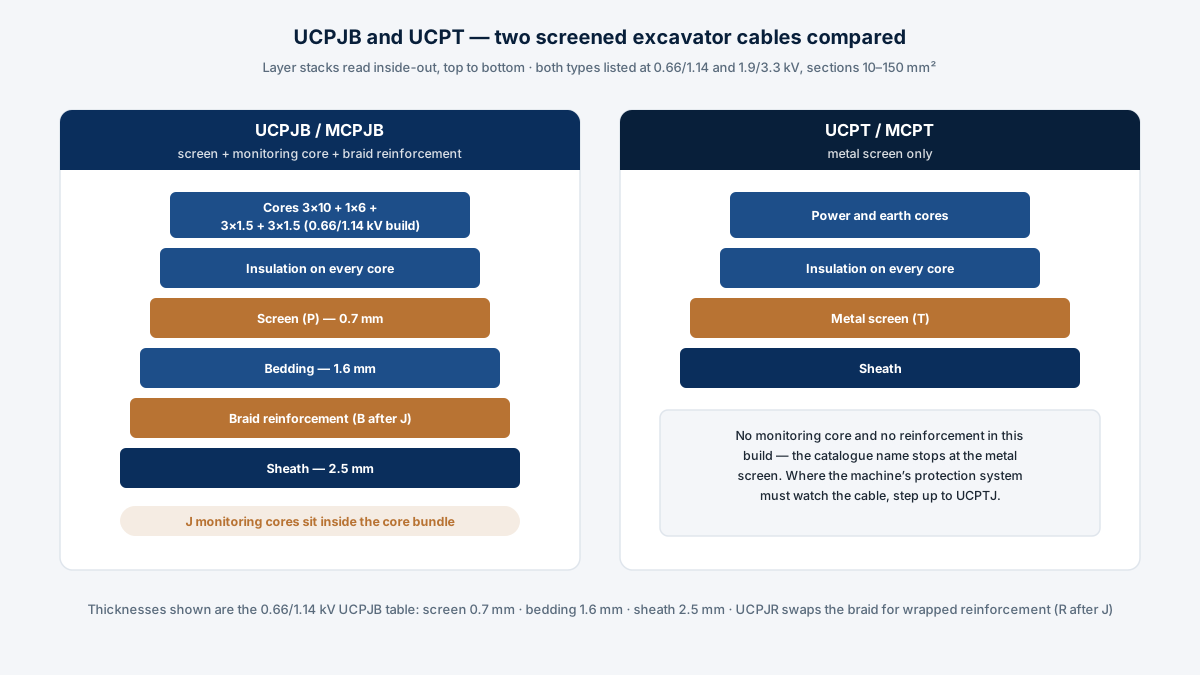
UCPJB or UCPT — reading the two routes
UCPJB and UCPT make the cleanest comparison in the family, because they share their voltage classes (0.66/1.14 and 1.9/3.3 kV) and their sections (10–150 mm²) while answering different specifications. UCPJB is the screened route taken to its full assembly — screen, monitoring core, braid reinforcement, and the bedding layer that sits under the braid. UCPT is the metal-screened route in its lean form: power and earth cores, insulation, metal screen, sheath — the catalogue name stops at the metal screen, and where the machine’s protection system must watch the cable, the step up within that route is UCPTJ, not a UCP build. One rule of thumb keeps the two families apart on any drawing: P-series letters build up from the screen, T-series letters build up from the metal screen, and J closes either route.
The selection ladder
| The duty | The specification | The type |
|---|---|---|
| Face equipment at 380/660 V, no screening requirement | Plain flexible excavator cable | UC / MC — 0.38/0.66 kV |
| Excavator, screened supply | Screen layer around the cores | UCP / MCP — up to 1.9/3.3 kV |
| Sophisticated face machinery, control system watches the cable | Screen + monitoring core + reinforcement | UCPJB (braid) / UCPJR (wrapped) — 0.66/1.14, 1.9/3.3 kV |
| Excavator on a metal-screened scheme | Metal screen, with or without monitoring | UCPT / UCPTJ — 0.66/1.14, 1.9/3.3 kV |
| Trailing and moving power at 3.3–6 kV | Screened or metal-screened moving cable | UYP (3.6/6 kV) / UYPT (1.9/3.3, 3.6/6 kV) |
| 6 kV and 10 kV trunk and moving feeds | Metal screen + monitoring core, top of ladder | UYPTJ — 3.6/6, 6/10, 8.7/10 kV |
Whatever the level, the service envelope is shared: conductor not above 90°C, ambient not below −10°C, withstand test at 3.5 × U0 for 5 minutes, minimum bending radius of 6×D up to 25 mm overall diameter and 8×D above it — wider than the rubber flexible families, because these cables are dragged and reeled — and no long-term sunlight exposure, these being underground-duty constructions. The flame-retardant route is available across the family, manufactured according to IEC 60332-2000 & GB/T 18380-2001 with the halogen-free and low-smoke addenda.
The excavator and moving families with their full dimension tables sit in the UC / UCP coal-excavator series and the UY / UYP mine-moving series; the BP- parallel listings and the full letter decode are covered in the companion articles. For a screened construction outside the type tables, the route is Custom by Standard, and the RFQ desk matches type codes against machine schedules directly — small runs of the standard series start at 500 m, and samples are available for evaluation.