Buyers sourcing rubber flexible cable from China meet two standard numbers on almost every datasheet: IEC 60245, the international system for rubber insulated cables, and GB/T 5013, the Chinese national adoption. The catalogue states the pairing directly — ordinary power cable is manufactured according to IEC 60245-2007 & GB/T 5013-2008 — and the relationship is not approximate. The two standards share type designations, dimensional tables and test levels, which is why a single drawing can carry both references. For the type codes themselves, see the companion guide YQ, YZ, YC, YH — A Field Guide to Chinese Rubber Cable Types.
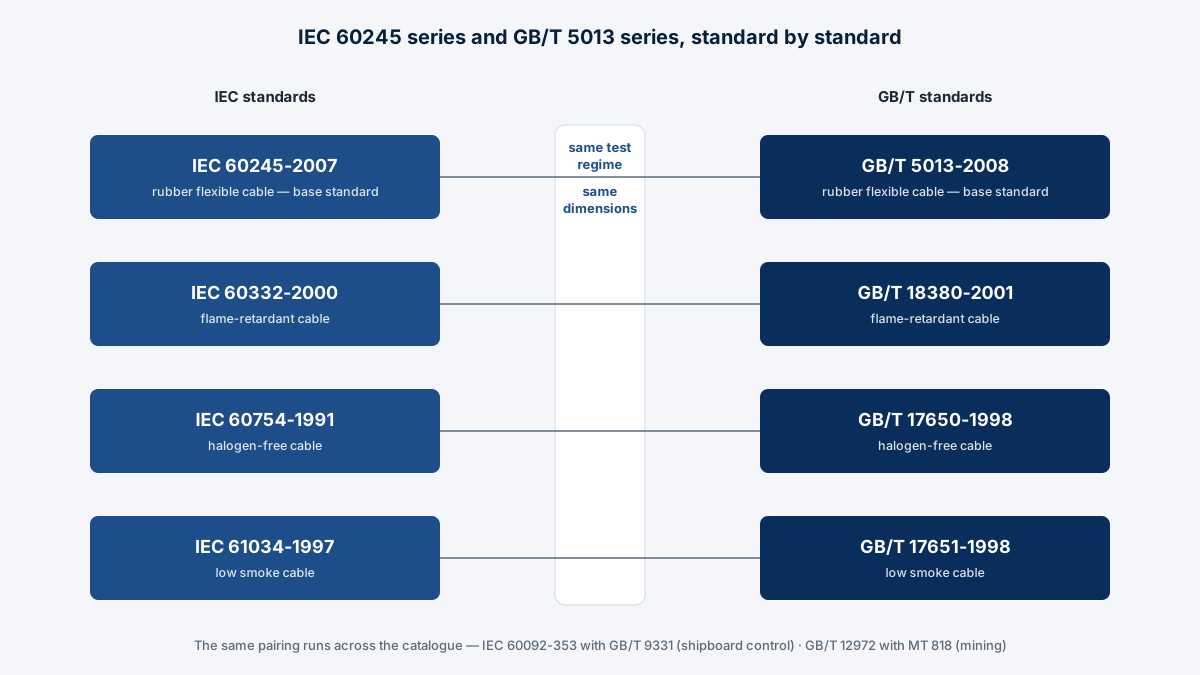
Two standards, one product family
GB/T 5013 is maintained as the Chinese national standard for rubber insulated flexible cables, aligned with the IEC 60245 series. In the catalogue the consequences are visible in three places. First, the executive-standard line names both documents with their editions: IEC 60245-2007 & GB/T 5013-2008. Second, the type table lists GB codes and IEC designations side by side — a row for “60245IEC53(YZ)” sits next to the plain GB row for YZ. Third, the dimension tables are printed under dual headings, for example “Type: 60245IEC66(YCW, YC)” — one table of conductor builds, insulation thicknesses, sheath thicknesses, overall diameters and weights serving both the GB and the IEC designation.
Type-for-type alignment
The mapping is fixed enough to quote in a specification. Rated voltages are written as U0/U — 300/500 V for the general purpose family and 450/750 V for the heavy duty family (the notation is unpacked in From 300/300 V to 8.7/10 kV).
| GB/T 5013 type | IEC 60245 designation | Rated voltage U0/U | Catalogue name |
|---|---|---|---|
| YQ | — | 300/300 V | Light duty rubber sheath flexible cable |
| YZ | 60245 IEC 53 | 300/500 V | General strength rubber flexible cable |
| YZW | 60245 IEC 57 | 300/500 V | General chloroprene or similar synthetic elastomer rubber flexible cable (outdoor type) |
| YC | 60245 IEC 66 | 450/750 V | Heavy duty rubber flexible cable |
| YCW | 60245 IEC 66 | 450/750 V | Heavy duty chloroprene or similar synthetic elastomer rubber flexible cable (outdoor type) |
| YH | 60245 IEC 81 | — | High strength rubber welding machine used cable |
| YHF | 60245 IEC 82 | — | High strength chloroprene or similar synthetic elastomer welding machine used cable |
Note what the table implies: YC and YCW share a single IEC designation (IEC 66), because the IEC code covers both the rubber-sheath and the outdoor elastomer-sheath versions — the GB system simply splits them with the W suffix.
The shared test regime
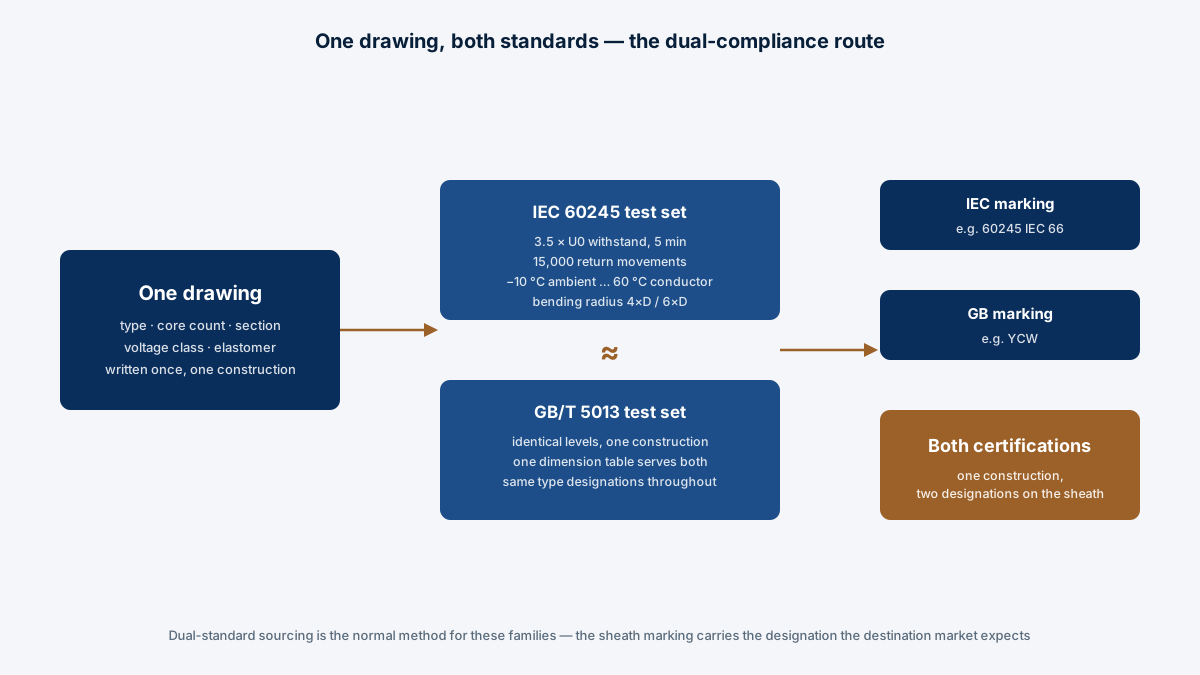
Whether the cable is ordered against IEC 60245 or GB/T 5013, the using properties are identical in the catalogue, and they are the numbers a test report is checked against:
| Property | Requirement |
|---|---|
| Rated voltage U0/U | 300/500 V or 450/750 V |
| Voltage withstand test | 3.5 × U0 for 5 min, without puncture |
| Yielding strength test | 15,000 return movements without circuit breakdown or short circuit between conductors |
| Operating temperature | Ambient not lower than −10°C; conductor not above 60°C |
| Minimum working bending radius | ≥4×D for D≤25 mm; ≥6×D for D>25 mm (D = overall diameter) |
The 3.5 × U0 withstand test is the anchor: because both standards scale the test voltage from the same U0 figure, a cable proven at 450/750 V under one system is proven at the same level under the other. The 15,000-cycle return-movement test is the flexing proof that separates rubber flexible cable from fixed wiring — the property that matters on drum cables, pendant leads and machine connections.
Beyond the base standard: the flame and smoke addenda
The pairing does not stop at the base cable standard. The same catalogue extends each family with three property standards, again cited as IEC + GB/T pairs:
| Property | IEC standard | GB/T standard |
|---|---|---|
| Base rubber flexible cable | IEC 60245-2007 | GB/T 5013-2008 |
| Flame-retardant cable | IEC 60332-2000 | GB/T 18380-2001 |
| Halogen-free cable | IEC 60754-1991 | GB/T 17650-1998 |
| Low smoke cable | IEC 61034-1997 | GB/T 17651-1998 |
The pattern holds across the wider catalogue as well — shipboard control cables pair IEC 60092-353 with GB/T 9331, and mining cables pair GB/T 12972 with MT 818 — so a European buyer can read a Chinese test document against the IEC clauses already written into their specification.
Why one drawing can satisfy both systems
Because the type designations, dimensional tables and test levels coincide, a single specification sheet can cite both standards without splitting the construction. In practice the drawing is written once — type, core count, section, voltage class, elastomer — and the marking on the sheath carries the designation the buyer’s market expects, whether that is a GB code such as YCW or an IEC code such as 60245 IEC 66. Dimensional checking is likewise single-source: the YZ/YZW table below is published under the combined heading “60245IEC53(YZ), 60245IEC57(YZW)” and applies equally whichever standard the order cites.
| Core × Section mm² | Conductor Dia. mm | Conductor No. | Insulation TH mm | Sheath TH mm | Overall Dia. mm | Weight kg/km |
|---|---|---|---|---|---|---|
| 2×0.5 | 0.20 | 16 | 0.5 | 0.7 | 5.9 | 41.9 |
| 2×0.75 | 0.20 | 24 | 0.6 | 0.8 | 7.0 | 59.9 |
| 2×1.0 | 0.20 | 32 | 0.6 | 0.9 | 7.4 | 68.8 |
| 2×1.5 | 0.25 | 30 | 0.8 | 1.0 | 9.0 | 104 |
| 2×2.5 | 0.25 | 48 | 0.9 | 1.1 | 10.5 | 144 |
| 2×4.0 | 0.30 | 52 | 1.0 | 1.2 | 12.1 | 199 |
| 2×6.0 | 0.30 | 75 | 1.0 | 1.3 | 13.3 | 253 |
Dual-standard designs of this kind — one construction satisfying GB and European requirements — are the normal working method for the rubber & flexible cable families listed here, and the Custom by Standard page describes the same approach across BS, VDE, NF and EN 50525 specifications. When a specification names a section or core assembly that sits between catalogue sizes, the drawing goes to the RFQ desk and is quoted as a custom run.